
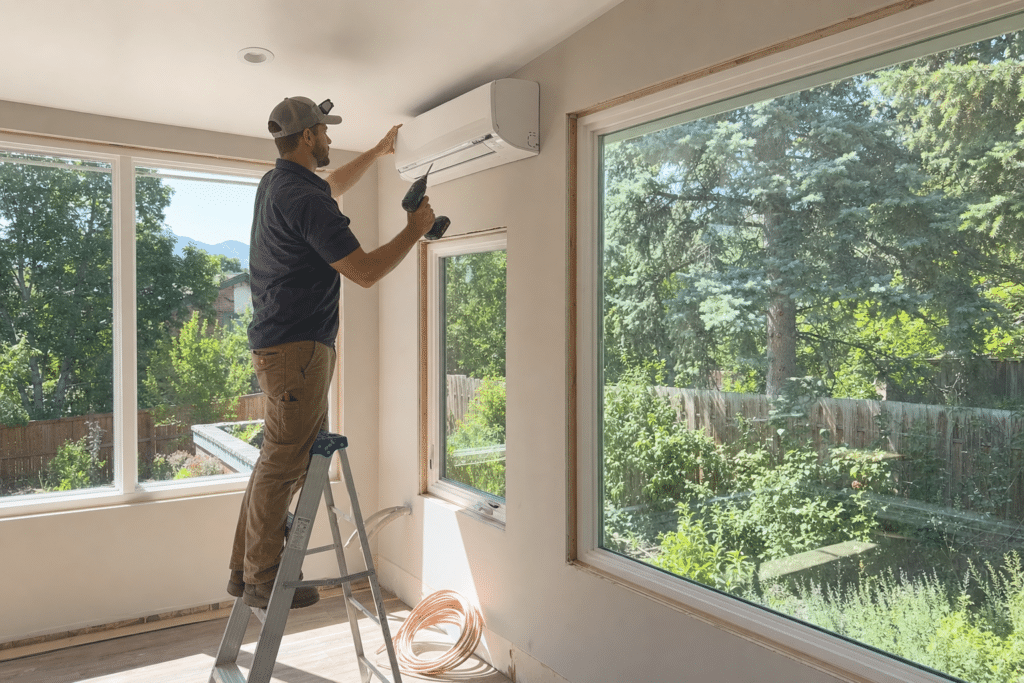
Room additions and garages are where ductless mini-splits make the most sense in Fort Collins. Extending ductwork is expensive, intrusive, and often technically difficult in an existing home. A mini-split gets a room to the right temperature without touching the rest of your system. Here’s what that actually looks like.
Quick Answer: A single-zone ductless mini-split installation in Fort Collins typically runs $3,200 to $5,500 fully installed, depending on unit capacity and installation complexity. These units provide both heating and cooling from one piece of equipment. In Northern Colorado’s cold winters, you want a unit rated for heating performance at low ambient temperatures, not just cooling.
Why Fort Collins Works Well for Mini-Splits
Fort Collins sits at around 5,000 feet. Winters get cold but not brutal, with overnight lows averaging in the teens in January, with occasional single-digit nights. That matters for mini-split selection because the older refrigerant-cycle designs had serious capacity falloff below 25 degrees. Current cold-climate inverter systems maintain rated heating output down to 5 or even minus 13 degrees Fahrenheit, which covers everything a Fort Collins winter throws at a residential system.
The elevation also means lower humidity than Denver. That’s actually good for mini-splits, which manage latent load (moisture removal) less efficiently at very low absolute humidity. Fort Collins summers are dry enough that the sensible cooling capacity is what matters most, and the units shine at that.
What Sizing Looks Like for a Room or Addition
The rough rule is 20 BTU per square foot for a well-insulated room in Fort Collins, adjusted for windows, ceiling height, and solar exposure. A 400 square foot sunroom with large south-facing glass needs more like 30 to 35 BTU per square foot because of the solar gain. A well-insulated 600 square foot addition with standard window area is probably in the 12,000 BTU range (1 ton).
| Room Size | Typical BTU Needed | Unit Capacity | System Cost Installed |
|---|---|---|---|
| Under 350 sq ft | 6,000 to 9,000 BTU | 9K unit | $2,800 to $4,200 |
| 350 to 600 sq ft | 9,000 to 12,000 BTU | 12K unit | $3,200 to $4,800 |
| 600 to 900 sq ft | 12,000 to 18,000 BTU | 18K unit | $3,800 to $5,500 |
| 900 to 1,200 sq ft | 18,000 to 24,000 BTU | 24K unit | $4,500 to $6,500 |
Don’t oversize. An oversized unit short-cycles, doesn’t dehumidify properly in summer, and bangs the compressor hard on every start. A properly sized unit runs at lower speeds for longer periods and handles both temperature and humidity much better.
How Mini-Splits Handle a Colorado Winter
A mini-split in heating mode is a heat pump. It doesn’t burn gas or resistance-heat. It moves heat from outside air into the room using a refrigerant cycle. Even at 20 degrees outside, there’s enough heat energy in the air to run this effectively, as long as the unit is rated for it.
A standard mini-split (not cold-climate rated) starts losing significant capacity around 35 to 40 degrees. In Fort Collins that matters because the cold season is real. If you’re using the unit as the primary heat source for the space, spec a Mitsubishi Hyper Heat, Fujitsu XLTH, Daikin Aurora, or equivalent cold-climate model. These are rated to minus 13 degrees Fahrenheit at reduced but functional capacity. A basic Senville or window-style unit is not.
Mini-Split vs. Extending Ductwork: The Honest Comparison
For most additions and garages, a mini-split is the right choice. Here’s why.
- Ductwork extensions are expensive. Running new ductwork from the main system through finished ceilings, across crawlspaces or attics, and into an addition typically runs $2,000 to $4,500. That’s often more than the mini-split itself.
- The main system may not have capacity. An existing HVAC system was sized for the original house. Adding 400 square feet of conditioned space without adding capacity means the system either can’t keep up or it short-cycles. You need new capacity either way.
- Mini-splits give you independent zone control. The addition runs on its own thermostat and doesn’t fight with the rest of the house.
- The garage case is even clearer. Garages in Fort Collins typically can’t be connected to the main home HVAC at all under Colorado code, because garage air is treated as contaminated. A mini-split is often the only legal option for a conditioned garage.
What the Installation Day Looks Like
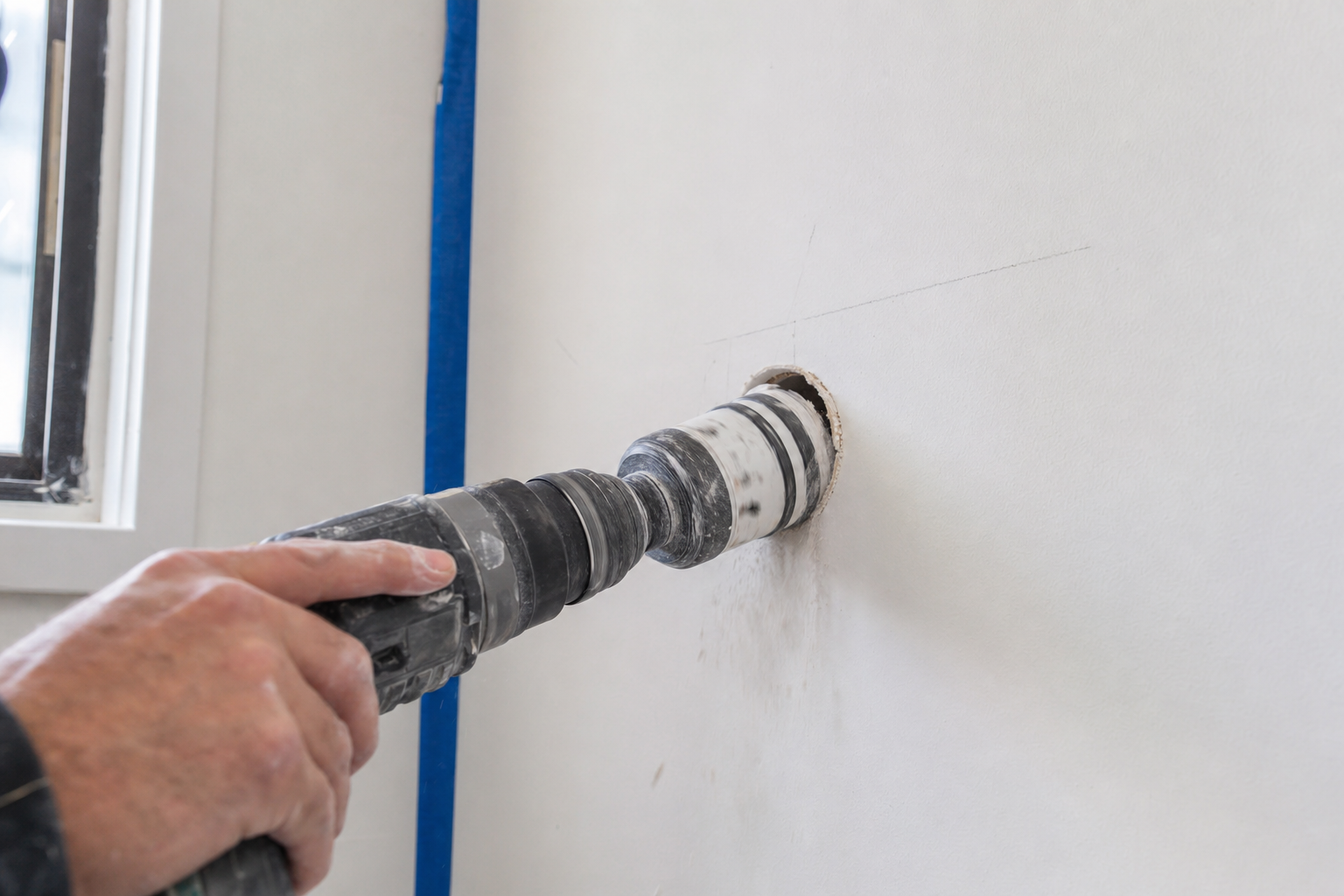
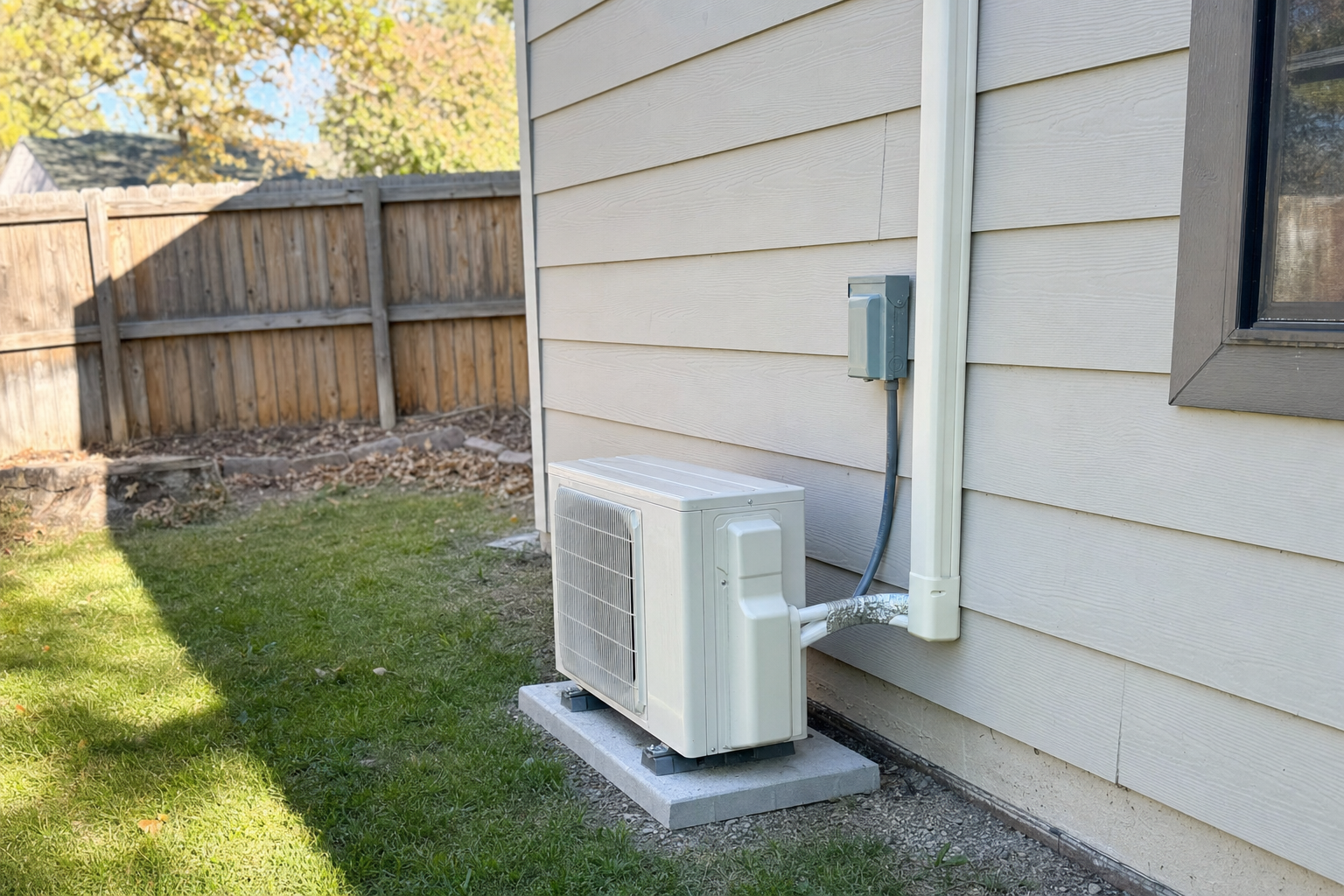
A single-zone mini-split install takes 4 to 6 hours for a two-person crew. The indoor head unit mounts on the wall in the room, usually high on an exterior wall. A lineset (refrigerant lines and electrical) runs through a 3-inch hole in the wall, down the exterior with a cover, to the outdoor condenser unit sitting on a small pad or bracket-mounted on the wall. The system gets charged, tested, and verified before the crew leaves.
The main variable is run length. A short lineset run to an outdoor unit right outside is simple. Running the lineset 40 feet around corners to get to the outdoor unit location you want adds time and cost.
Rebates and Credits Available in Fort Collins
Fort Collins Utilities (not Xcel, for most Fort Collins addresses) offers rebates on high-efficiency heat pumps. Current rebates for qualified mini-splits run $200 to $600 depending on HSPF and SEER ratings. That’s in addition to the federal 25C tax credit, which covers 30% of the installed cost up to $2,000 per year for qualified heat pumps. Stack both and the math gets better.
Getting a Quote in Fort Collins
Cool Ducts handles ductless mini-split installation across Fort Collins, Loveland, and Greeley. When you call for a quote, have the room dimensions and window count ready. It makes the conversation faster.
If you’re adding a conditioned space to your home and wondering how to heat and cool it, a mini-split is the answer in most cases. Call 970-405-5333 to set up a site visit.