
Single-zone mini-splits run $2,800–$5,500 installed in Greeley. Full guide to how they work, sizing, heat pumps, and what to expect on installation day.
Got a call in March from a homeowner in south Greeley. Two-story house, forced-air furnace that worked fine, but the upstairs bedrooms were 10 degrees warmer than the main floor all summer. She wanted to know if a mini-split could fix it without touching the duct system. It can. Here’s how it works and what it costs.

What is a ductless mini-split and how does it heat and cool your home?
A ductless mini-split has two components: an outdoor compressor and one or more indoor air handlers. Refrigerant lines connect them through a small hole in the wall — usually 3 inches in diameter. That’s the only penetration you need.
The indoor unit mounts high on the wall, draws in room air, runs it across a refrigerant coil to cool or warm it, and returns conditioned air directly to the space. No ducts. No air lost through leaky ductwork. The refrigerant does the work.
Heat pump versions — which is most mini-splits — can both heat and cool by reversing the refrigerant cycle. In heating mode, the system pulls heat energy from outdoor air and moves it inside. It doesn’t generate heat; it moves it. That’s why heat pumps are more efficient than electric resistance heaters. Modern cold-climate units like the Mitsubishi Hyper-Heat series operate down to -13°F.
Is my older Greeley home a good candidate?
Mini-splits make the most sense in a few specific situations.
- Homes without ductwork — older Greeley ranch homes built before 1970 often have boiler heat and no ducts at all
- Additions where extending ductwork would be costly or invasive
- Rooms that are chronically uncomfortable relative to the rest of the house (hot upstairs bedrooms, cold bonus rooms over the garage)
- Sunrooms, finished basements, or converted garage spaces
Mini-splits are less compelling if your existing ductwork is in good shape and serves the whole house. In that case, a central system is more cost-effective per square foot. The question isn’t ‘is a mini-split good?’ — it’s ‘is a mini-split right for this specific situation?’

How many indoor units do you actually need?
One outdoor compressor can power multiple indoor units in a multi-zone configuration. Most residential systems support 2–5 zones from a single outdoor unit.
Sizing: each indoor unit needs to match the load of its space. A 12,000 BTU (1-ton) unit handles roughly 400–600 sq ft, depending on insulation and window exposure. Oversizing causes the same problem as with central air — the unit short-cycles, runs in bursts, and doesn’t control humidity well.
| Zones | Typical BTU configuration | Installed cost range |
|---|---|---|
| 1 zone (single room) | 9,000–18,000 BTU outdoor, 1 indoor unit | $2,800–$5,500 |
| 2 zones | 24,000–36,000 BTU outdoor, 2 indoor units | $5,000–$9,000 |
| 3 zones | 36,000–48,000 BTU outdoor, 3 indoor units | $8,000–$14,000 |
What does mini-split installation cost in Greeley?
The biggest variables are line set length, floor count, and electrical work. Each 15 feet of refrigerant line over the standard run adds $100–$200. Multi-story installs where the outdoor unit can’t be close to the indoor units add labor. And a 240V dedicated circuit is required per outdoor unit — if your panel doesn’t have capacity, add $500–$1,200 for electrical work.
Brand choice matters too. Entry-level units from mid-tier brands are $400–$800 cheaper than Mitsubishi or Daikin equipment, but Greeley winters regularly drop below 15°F. The premium cold-climate models maintain their efficiency rating at those temps. The cheaper units don’t. Over a Colorado heating season, that gap in performance adds up.
Heat pump vs cooling-only: why heat pumps win in Greeley
Greeley averages 34°F in January, with regular nights below 15°F. A standard mini-split heat pump handles that range. Cold-climate models handle everything Greeley throws at them. If you’re buying a mini-split primarily for summer cooling, you’ll almost certainly get a heat pump version anyway — the additional cost over a cooling-only unit is minimal, and you gain a useful heating source for the 40-degree spring and fall nights that Colorado is full of.
Cooling-only mini-splits exist but are increasingly rare and don’t make financial sense for a Northern Colorado installation. Buy the heat pump version.

What to expect on installation day
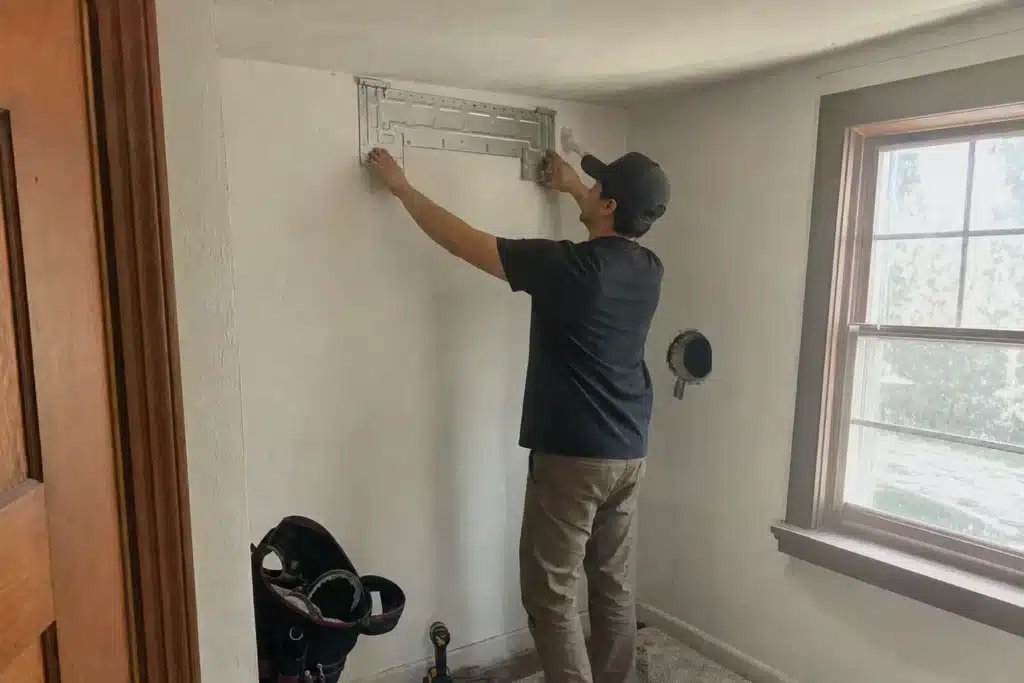
A single-zone installation typically takes 4–6 hours with a two-person crew. They mount the indoor bracket, core a 3-inch hole through the exterior wall, run refrigerant lines and the drain line to the outdoor unit, set and level the condenser on a pad or wall bracket, charge the system, and test it through all operating modes. You’ll know it’s working when the first cycle runs — mini-splits are noticeably quieter than window units or floor registers.
Your contractor pulls the Greeley permit, and a Weld County mechanical inspector signs off after the install. Budget an extra week for the inspection window.
If you’re thinking through ductless for an addition, an older Greeley home, or a room that’s never been comfortable, our ductless systems team can size and spec the right configuration for your layout. We do mini-split AC installation in Greeley throughout Northern Colorado and size them with an actual load calculation, not a guess.
A mini-split isn’t the right answer for every home. But for the right situation, it’s one of the best comfort investments you can make — quiet, efficient, and no ductwork required.
Fort Collins homeowners increasingly choose ductless mini-split systems for their energy efficiency and zone-based comfort. Unlike traditional forced-air systems, mini-splits deliver heating and cooling directly to individual rooms without ductwork, making them ideal for older Fort Collins homes, room additions, and garage conversions. Cool Ducts HVAC installs and services all major mini-split brands across Fort Collins and Northern Colorado. Our NATE-certified technicians handle everything from system sizing and design through final commissioning. Call 970-405-5333 for a consultation.