
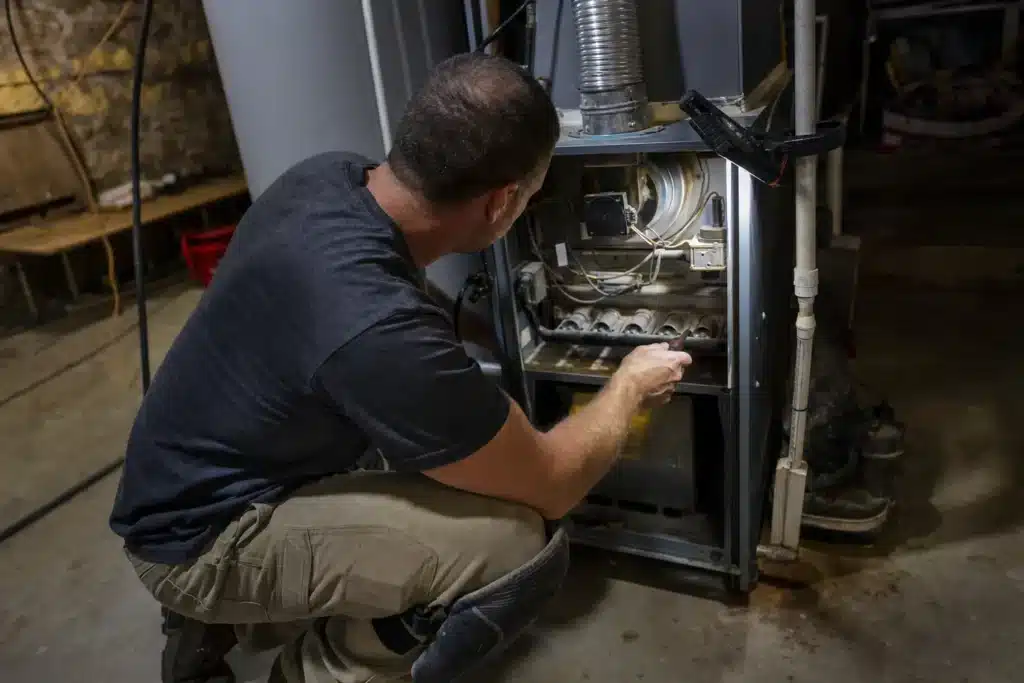
A furnace tune-up in Fort Collins costs $80–$150 and takes 90 minutes. Full breakdown of what the tech checks and why skipping it costs more in the long run.
Monday in late September, I get a call from a homeowner on Horsetooth Road. Their furnace ran fine all last winter. They skipped the annual tune-up because ‘nothing seemed wrong.’ Now it’s been running for six hours and the house is still 58 degrees. The igniter was coated in dust and partially cracked. A $30 part — or $80 if we caught it during a tune-up — turned into a $290 service call in the middle of a cold week. Here’s what an annual tune-up actually includes and whether it’s worth it.

What does a furnace tune-up actually include?
The specific checklist varies by contractor, but a thorough tune-up should cover all of this.
- Inspect and test the igniter — the igniter is the most common failure point on modern gas furnaces. A hairline crack or carbon buildup causes no-heat calls. Catching it during a tune-up costs $30–$80; replacing it on an emergency call is $180–$300.
- Clean the burners — dust and rust scale on the burners cause incomplete combustion, reduced heat output, and carbon monoxide risk.
- Check the heat exchanger — a cracked heat exchanger can let combustion gases into your living space. Non-negotiable safety check.
- Test the flue and combustion venting — looks for blockages, backdrafting, and proper draft.
- Check and lubricate the blower motor — a dry blower motor runs hotter, uses more electricity, and fails earlier.
- Measure static pressure and airflow — catches duct restrictions or a clogged filter causing the system to work too hard.
- Test controls, safeties, and thermostat calibration — limit switches, pressure switches, and the rollout switch.
- Inspect and replace the air filter if needed

How often should Fort Collins homeowners schedule one?
Once a year, every fall. That’s the standard. Northern Colorado winters are hard on HVAC equipment — cold temperatures, dry air, and furnaces that run nearly continuously from November through March. Annual maintenance is calibrated to that cycle.
If you have a two-stage or variable-speed furnace (common in homes built after 2010), some contractors recommend a spring checkup as well. Those systems have more electronics and run almost continuously at low stage rather than cycling on and off, which changes the wear pattern. One annual visit is the minimum; twice is better for high-efficiency equipment.
What the tech actually checks during a Fort Collins furnace inspection
The heat exchanger inspection gets special attention in Colorado. Our average humidity in Fort Collins is around 40–50%, which is reasonable — but we get wide temperature swings. That thermal cycling stresses the heat exchanger over time. Cracks in a heat exchanger allow combustion gases (including carbon monoxide) to mix with supply air. Carbon monoxide has no smell. It’s the reason this check matters.
The other Fort Collins-specific thing we watch: dirt and debris on the outdoor portion of heat pump systems (common in newer construction). The constant wind here pulls cottonwood seeds, dried leaves, and dust through the coil fins. Once per year, cleaning those fins restores efficiency.
What happens if you skip it?
Usually nothing for a year or two. Then something fails. The failure rate for furnaces that haven’t had maintenance in 3+ years is meaningfully higher than maintained equipment — and the failures tend to happen on cold days in January, not mild days in October, because that’s when the furnace is running hard.
The numbers: the average emergency HVAC call in Fort Collins runs $250–$450. An annual tune-up runs $80–$150. You’re not saving money by skipping it — you’re just concentrating the risk into a worst-case repair scenario.
Cost of a furnace tune-up vs emergency repair in Fort Collins
| Service | Typical cost | Timing |
|---|---|---|
| Annual furnace tune-up | $80–$150 | Scheduled, October or early November |
| Emergency igniter replacement | $180–$300 | Unscheduled, usually mid-winter |
| Emergency gas valve replacement | $350–$600 | Unscheduled |
| Emergency blower motor replacement | $400–$700 | Unscheduled |
| Heat exchanger replacement (vs furnace replacement) | $700–$2,000 | Major repair, often leads to replacement |
The best time to book in Fort Collins
Late September through October is the sweet spot. Before the heating season starts, before the November cold snaps hit, and before contractors’ schedules fill up. If you wait until November, you’re competing with homeowners whose furnaces already stopped working. Late September you’ll get your pick of appointment times.
Don’t skip it if the furnace is older than 10 years. That’s when the heat exchanger, blower motor, and gas valve start reaching end-of-life territory. Knowing their condition before winter starts is worth the cost of the visit alone.

Our furnaces and tune-up services cover the full checklist above, every time. If you’re in Fort Collins and your furnace hasn’t had a tune-up in the last 12 months, now is the right time to schedule it. You can also read about our furnace maintenance in Fort Collins for more on what we check and how we approach older equipment.
The math is simple: $80–$150 in the fall, or $250–$700 in January. One of those is a scheduled appointment at a reasonable time. The other is an emergency call when every contractor in town is busy. Schedule the tune-up.